
The following are not films that necessarily belong in the horror genre. Most of them can be categorized as dramas, at least for the general audience. For writers, on the the other hand, they are campfire horror stories full of shriek-inducing terrors that will send a cold chill down every writer's spine.
Horrors such as writer's block, creative insecurity, self-doubt, impending poverty due to not being able to sell your work, that nagging feeling that always reminds you that no matter how hard you try, you might never make it as a writer.
These are films that present and exploit these horrors in such a brutally honest and relentless way, they force us writers to face our innermost fears head on. For us, they are horror films that make us wince in our seats at how familiar the writer's worries and insecurities feel to us.
Although these are great films in their own right, they should not be watched alone by struggling writers, especially during writer's block or moments of extremely low self-esteem.

5- Sunset Boulevard:
To me the horror in Sunset Boulevard doesn't come from knowing William Holden will die at the end. Billy Wilder's masterpiece created one of the most famous and continuously ripped-off (I'm looking at you "American Beauty") story devices in film history. But that device provides the film's suspense. You see Holden dead at the bottom of the pool in the first scene, and for the rest of the film wonder how he's going to die. That's suspense.
The writer's horror, on the other hand, comes from a nightmarish situation every writer has faced at one point: Writing something you know is a piece of crap for someone you know is either a hack or a nut job (In this case, the nuttiest of them all, Gloria "I'm ready for my close-up" Swanson). And why do you do it? Because there is no one else interested in your writing and you think this is your last chance at ever making anything out of your life. You try and you try and what happens at the end? You end up dead at the bottom of the pool.
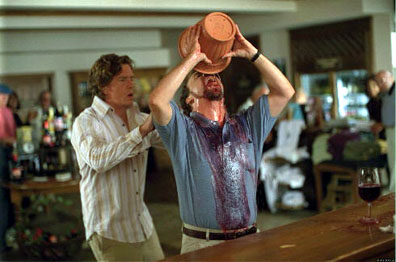
4- Sideways:
Any "still aspiring" writer in their 40s and up should steer clear from Sideways. Hell, I was 25 when I saw it and it scared me so bad, I refuse to see it again. What's so terrifying about an indie darling about wine tasting? Paul Giammatti's pathetic middle-aged writer Miles.
Still unpublished, divorced and a disgusting douche bag as his only friend, Miles is the equivalent of "Scared Straight" for young writers. A boogeyman to keep us motivated into finding another career. "Make sure you find something else to do with your life kids. Otherwise no matter how hard you try and how much you motivate yourself, you'll more than likely end up like Miles."
The most terrifying scene? After hearing about how the only thing Miles has left to cling to life is the publication of his book for an hour and a half, he finds out that the book will not be published. And what does he do to deal with the pain? He pours an entire barrel of wine on his face and makes an even bigger ass of himself than he ever did.

3- Adaptation:
In its core, Adaptation is about a writer who starts a new script with the best of intentions and can not find his way out of it midway through. So he throws more and more random stuff at it, thinking it will help him find a way out, but it just gets worse and worse. Entire plot lines start to not make any sense, characters say things they would never say and even the faintest hope of finding an ending fizzles away. In the end we become so desperate, we attend a Robert McKee seminar, shouting in our heads, "What the fuck am I doing here!?"

2- Barton Fink:
For whatever reason, if anybody wants to see what the inside of a writer's mind looks like, watch Barton Fink.

1- The Lost Weekend:
This is the big one. The head honcho. If you show The Lost Weekend to a young idealist writer who's still filled with glorious hopes and dreams about his future as the greatest author of his generation, you're a scumbag. Let the kid dream for a while.
Billy Wilder's best picture winner from 1945 is about a weekend in the life of Don Birnam (Way too convincingly played by Best Actor winner Ray Milland), a barely functioning alcoholic who used to show a lot of promise as a young man, but hasn't finished a novel in decades. The film follows Birnam aimlessly wondering through life, ignoring his friends and family, doing anything to score a drink and trying desperately to hold onto a semblance of a fresh start that will eventually topple down as soon as he drinks his next shot.
What's that you say? I'm not an alcoholic? Well, that doesn't matter because the bone-chilling horror of The Lost Weekend does not come from the fact that Birnam is an alcoholic. His alcoholism is barely a reaction to the real issue: Cripplingly low self-esteem and a gradual decrease in productivity due to years of rejection after being hailed as the next best thing. Even if you take the alcohol out of the equation, we are still left with the cyclical nightmare: Being inspired by a fresh new idea, gradually becoming more and more disheartened about its outcome and finally, giving up. Repeat the process.
Oh yes, I know about the film's deceptive "happy ending". But here's a little clue: The shot that ends the film is the reverse of the establishing shot that begins it, therefore the first frame and the last frame of the film are the same. This is Billy Wilder's ingenious way of letting us know that while it looks like the story ends, we are actually all the way back at the beginning again. Nothing has changed. Sweet dreams.

