I realize that this is kind of cheating. But I was in the process of creating my 10 best films of the 2000s article for beyazperde.com and I came upon a minor writer's block. So I thought I'd try it first on this blog as a more free-form first draft. Also, since the beyazperde article is going to be in Turkish, I kinda like the idea of having a more detailed English version on hand.
So how does this belong in Top 5 Movies? After all, I did set for myself the rule that all of the blog entries will involve some form of top 5 about movies. Well, the way I get around that this time is by posting the first five entries in the list, plowing through numbers 10 through 6, and then presenting the grand finale involving the "real" top 5 in another entry. Technically, this counts.
Right off the bat, I have to admit that this was my idea. I contacted my editor and suggested a Top 10 Films of The Decade article. So in a way, this is not really an assignment. It's more of an interest. I know the 2000s officially end with 2011 but the reason I thought of doing this now is because every other critic already started posting their lists, so I didn't want to be left out. Also, I like making movie lists, hence this blog.
Looking back, how does the first decade of the new millennium fare compared to the older decades? Pretty good, actually. Browsing through various favorites from the 00s, I came across many masterpieces. Great movies that will be remembered for years to come.
In retrospect, 2007 was the best year of the decade. I remember referring to that during conversations with friends months before the year even ended. That's how you know it was a great year. Although I'm sure this happened completely by coincidence, 2007 saw a surprisingly strong return to the dark, edgy, brutally honest yet joyfully stylized character driven films of the 70s, the best decade for American cinema.
2004, on the other hand, proved to be the weakest year. In fact, 2004 was so weak, I could not find a single film worthy of a spot on the list, so I opted on picking two titles from 2007. No films from the worst year, covered by two films from the best. It seems fair to me.
Otherwise, there is exactly one film on the list per year. I simply picked my favorite film from each year and made a chronological list. That was the easy part. The excruciatingly hard part was to measure their greatness. In many different ways, these films are equally great. I just had to go by my gut reaction ("Go by the gut" is a proud credo of The Colbert Nation) regarding how much I love each film, so here you go.
The best films of the 00s, entries 10 through 6:
The best films of the 00s, entries 10 through 6:

10- The Weather Man:
In my humble opinion, this is easily the most underrated gem of the decade. When The Weather Man was released in October 2005, it kind of passed through theaters without much recognition from the audience, who probably did not know how to react to what looked like a big Hollywood drama with a big Hollywood star (Nicholas Cage) that was surprisingly unconventional and brutally honest.
The Weather Man did have a large budget and impressive star power, but it had the soul of a character-driven indie drama. In lots of ways, it's better than all the critically-acclaimed indie darlings of the 00s. It had a very dry sense of humor, yet it did not overdo it by adding the sugary sweet "quirk factor" that spreads like a cancer on almost all indie dramas. It was a reflective study of a man lost in his mid-life crisis, but it wasn't unnecessarily gloomy or depressing.
In its core, The Weather Man is about the search for a man's place in life. It's about that time in our lives where we really start asking ourselves, "What am I doing here? What is my purpose? What am I good for?"
Local Chicago TV Weather Man Dave Spritz (Nic Cage) might be financially successful without having to do much work, but his respected author father (Michael Caine in what might be his greatest performance) doesn't respect him, his ex-wife loathes him and his children barely know his name. He is not really a likable man. He always looks mopey, is usually rude to people and sometimes he can't even get the most basic tasks done, as seen during the brilliant flashback scene about "The Tartar Sauce!" Yet we sympathize with him because deep inside, he yearns for the most familiar basic needs: The need to have a happy family, the need to be respected, to be loved.
Instead of building a traditionally cynical sob story about this guy, screenwriter Steve Conrad and director Gore Verbinsky (Who directed all three Pirates of The Caribbean, go figure) intricately construct the story on a series of small moments, reminding us that the big answers about our lives usually lie in the little details. The Weather Man deserves to be sought out and rediscovered.
In my humble opinion, this is easily the most underrated gem of the decade. When The Weather Man was released in October 2005, it kind of passed through theaters without much recognition from the audience, who probably did not know how to react to what looked like a big Hollywood drama with a big Hollywood star (Nicholas Cage) that was surprisingly unconventional and brutally honest.
The Weather Man did have a large budget and impressive star power, but it had the soul of a character-driven indie drama. In lots of ways, it's better than all the critically-acclaimed indie darlings of the 00s. It had a very dry sense of humor, yet it did not overdo it by adding the sugary sweet "quirk factor" that spreads like a cancer on almost all indie dramas. It was a reflective study of a man lost in his mid-life crisis, but it wasn't unnecessarily gloomy or depressing.
In its core, The Weather Man is about the search for a man's place in life. It's about that time in our lives where we really start asking ourselves, "What am I doing here? What is my purpose? What am I good for?"
Local Chicago TV Weather Man Dave Spritz (Nic Cage) might be financially successful without having to do much work, but his respected author father (Michael Caine in what might be his greatest performance) doesn't respect him, his ex-wife loathes him and his children barely know his name. He is not really a likable man. He always looks mopey, is usually rude to people and sometimes he can't even get the most basic tasks done, as seen during the brilliant flashback scene about "The Tartar Sauce!" Yet we sympathize with him because deep inside, he yearns for the most familiar basic needs: The need to have a happy family, the need to be respected, to be loved.
Instead of building a traditionally cynical sob story about this guy, screenwriter Steve Conrad and director Gore Verbinsky (Who directed all three Pirates of The Caribbean, go figure) intricately construct the story on a series of small moments, reminding us that the big answers about our lives usually lie in the little details. The Weather Man deserves to be sought out and rediscovered.

9- Almost Famous:
Cameron Crowe started the 00s strong with 2000s Almost Famous. He also crashed and burned with 2005s Elizabethtown but I choose to focus on his glory days as opposed to his later embarrassments.
Based on Crowe's own experiences as a 15-year-old reporter for the Rolling Stone, touring with bands like Led Zeppelin and The Who (A.K.A. The Luckiest Teenager Ever), the film follows (surprise, surprise!) 15-year-old William Miller's (Patrick Fugit) often exhilarating, sometimes frustrating journey with the fictional band Stillwater and their "band-aids".
Since it's based on real life experiences that are obviously very near and dear to Crowe, the film immediately instills in us an intimate feeling of familiarity. Every step of the way, we feel like we personally know the characters. We feel as if we are watching our own memories (Wishful thinking, I know).
It's an endlessly endearing film, full of life and energy, much like the music.

8- There Will Be Blood:
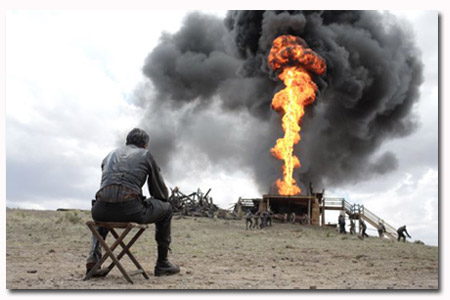
If there is one film on my list that will remain a bona fide American classic and will be discussed in film schools in 50 years, this is it. With its impeccable direction full of perfectionist touches that would put Kubrick to shame, its awe-inspiring, "freeze-a-random-frame-and-hang-it-on-your-wall" cinematography and its powerhouse lead performance that will crush all other less-worthy powerhouse performances (Daniel Day-Lewis in the best performance of the decade, bar none), There Will Be Blood is a film lover's heroine, pure and uncut. Primo stuff.
That's not to say it's an easy film to warm up to. As remorseless and cold as his protagonist, it took me a couple of views before I could even get to grips with the film's visceral power. After I saw it in the theater near the end of 2007, it didn't even make it on my beyazperde Top 5 list for the year. After watching it again and letting its mastery wash over me, I can safely say it is one of the most powerful American films ever made. Who knows, maybe after watching it a couple more times, it might move up on this list as well.
7- Up:
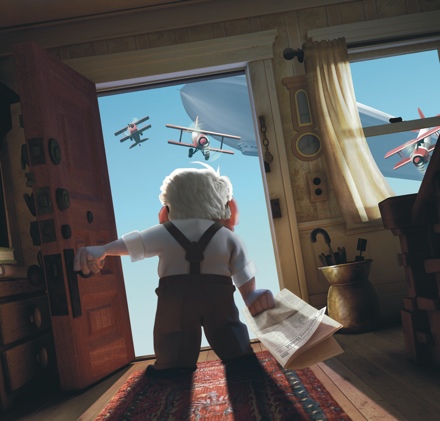
The decade ends with 2009's Up, a true animation classic. One that not only presents an endlessly exciting and breath taking adventure, it also accomplishes something seldom seen in American animation: It has real characters, with real feelings, dreams and motivations. Even though it is part of a format generally marketed to kids, not one frame of it has even a speck of that familiar pandering and condescension observed in countless animated films, especially ones that were released during the 00s.
Underneath the delightful fantasy of Carl Fredericksen, a cranky septuagenarian, voyaging to Paradise Falls with his flying house to fulfill a promise to his wife Ellie, lies a beautifully told story about a man's personal journey into dealing with his own grief and finding new purpose in his life, executed with endless empathy and compassion.
Directors Pete Docter and Bob Peterson go out of their way to crush every children's film cliche known to man. Russell, Carl's unwanted child companion, is not treated as an adult in a child's body, the way children are depicted in almost every family film, but as a real child, confused, goofy and sometimes even annoying. The talking dogs don't have human characteristics or mannerisms, they simply articulate a dog's thought pattern. Balls are good, squirrels are bad. This is, quite simply, a wonderful film.
6- Adaptation:
Screenwriter Charlie Kaufman made his mark on the 00s with his own brand of off-beat, self-referential, post-modern work. Kaufman has a knack for wryly examining the deepest regions of the human soul. Some critics are already calling Eternal Sunshine of the Spotless Mind, which I thought was over-written and too Gondry-fied, one of the best films of the decade.
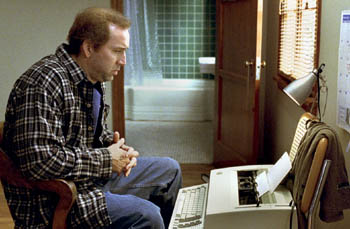
I think Kaufman's best work is the delightful Adaptation. When he couldn't find a feasible way to adapt Susan Orlean's non-fiction book The Orchid Thief, Kaufman inserted himself into the script, created a fictional twin brother and used this wide palette to examine everything from sexual frustration, writer's block, sibling rivalry, Charles Darwin and of course, orchid thieves.
Much like the ouroboros, a symbol of a snake that eats itself, referenced in the film by Charlie's simple-minded-yet-more-sexually-active brother Donald, Adaptation devours and recreates itself as it moves along. The film bashes certain storytelling gimmicks constantly used by Hollywood such as voice-overs and action-oriented finales full of fist fights and car chases, only to conclude with a ridiculously conventional ending that utilizes every cliche in the Hollywood playbook, including ending with a (you guessed it) car chase and a heart-warming pop song ("Happy Together" by The Turtles).
I know Nicholas Cage has made some bad choices during this decade. Ghost Rider and The Wicker Man are the first ones that comes to mind among a double-digit list of crappy films. But the fact that he gave two of the best performances of the 00s more than makes up for his sins.
His personification of the morbidly neurotic Charlie Kaufman and his goofball brother Donald are pitch perfect. Cage's take on these two characters are so distinctive, we can always immediately tell which brother we're looking at even though no make-up was used to visually distinguish them.
Adaptation is one of those films that is surprising and unpredictable at every turn. So far, this is the final pair-up of director Spike Jonze and Charlie Kaufman along after the almost equally brilliant "Being John Malkovich". Even if this is their final effort together, it's certainly not a bad end.


No comments:
Post a Comment